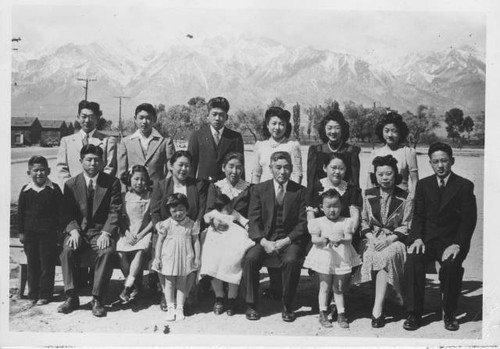
Despite the fact that she often depicted Americans in desperate situations and of humble conditions, Dorothea Lange sought to portray an optimistic view of American life. Lange wanted to show that despite the struggles marginalized facets of American society faced, their humanity always shined through. As Linda Gordon, the author of “Dorothea Lange: A Life Beyond Limits” asserts, there is a sort of contradiction within Lange’s body of work. Within the reality created by Lange’s photography, American democracy is “incomplete,” while simultaneously being something that is achievable by her work’s modest subjects (p. 2). Thus, Lange’s work is democratic in both its ideals as well as its representation, as those of all walks of life are captured throughout.
A facet of Lange’s work that embodies these democratic ideals is her work capturing the wide range of Japanese Americans held in internment camps during the second world war. One particular photo, titled “Three generations of the Uchida family at Manzanar War Relocation Center,” is able to capture the humanity of individuals who are arguably victims of the aforementioned “incompleteness” of American democracy. The photo, shown above, is framed as a simple family portrait, showing several rows of Uchida family members. By framing the image in this way, a conventional family portrait, Lange seeks to counteract much of the “othering” that was done to Japanese Americans during the time via discriminatory wartime propaganda. Here, Lange shows these individuals as equals, embodying the idea of democracy visible in her work. Thus, Lange’s skills as a photographer, specifically through a deliberate use of framing and composition, help to bring dignity and humanity to subjects that were otherwise looked down upon by the rest of American society.
Leave a Reply